The Art of Go / No Go: Turning Decision-Making into a Growth Lever for Your Ecosystem
Because saying "yes" or "no" isn't just a reflex — it's an act of governance.
Introduction
In an ecosystem where everything moves faster, the difference between those who grow and those who burn out often comes down to one thing: the quality of their decisions.
In partnerships as in innovation, enthusiasm can be a driver… or a trap. Too often, companies spend weeks negotiating "nice" alliances — promising on paper, but not viable in reality.
The issue isn't intuition; it's essential to capture weak signals and open new opportunities. The real challenge lies in governance — being able to frame decisions with clarity and rigor, transforming intuition into tangible growth.
From Intuition to Decision: Building the Balance
In innovation ecosystems, everything happens fast. Alliances multiply, roadmaps evolve, and time-to-market becomes a decisive lever for maintaining competitive advantage.
Decision-makers shouldn't focus on multiplying processes but on fostering structured decision-making — without slowing down execution. In other words, building a framework where intuition remains a starting point, but validation relies on clear, shared criteria.
Go / No Go / Stop Governance: A Strategic Arbitration Method
Sustainable growth depends as much on the decisions we make as on the ones we don't. That's why I formalized the Go / No Go / Stop Decision Framework, designed to help executive committees and boards align strategy, resources, and execution tempo.
This model is built on five interdependent analytical dimensions:
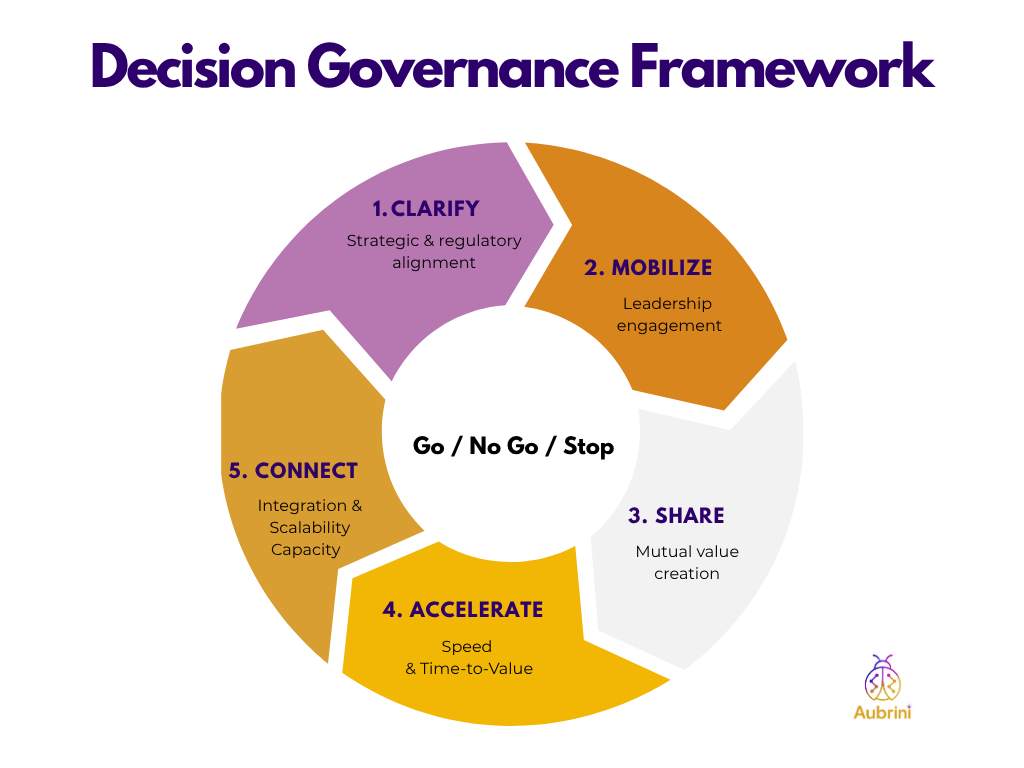
1. Strategic and Regulatory Alignment
Does the partnership support the company's long-term trajectory while meeting expected compliance, security, and reputation standards? An opportunity misaligned with the mission or regulatory framework often creates complexity rather than value.
2. Leadership Engagement
Is the C-level sponsor truly mobilized to drive collaboration beyond rhetoric? Strong governance requires visible commitment, a clear decision relay, and shared accountability between the two organizations.
3. Mutual Value Creation
Does the partnership create measurable leverage for both business models? Beyond co-marketing, it's about identifying real synergies: market gain, cost reduction, shared innovation, or access to new segments.
4. Speed and Execution Trajectory
What is the time window before a tangible impact appears? Time-to-Value becomes a key indicator: a strategic partnership is measured by its ability to generate visible results without destabilizing operational priorities.
5. Integration and Scalability Capacity
Are infrastructures, teams, and processes ready to cooperate and grow together? A solid partnership relies on well-managed technical, cultural, and managerial interoperability.
This framework doesn't slow down decisions — it creates the conditions for aligned speed, where each "yes" becomes an investment in trust and each "no" a strategic time-saving decision.
The Role of an Advisory Board: Deciding with Depth and Responsibility
In too many organizations, Advisory Boards limit themselves to validating, commenting, or staying on the surface. Some members engage little, arrive late, and settle for a comfortable consultative role.
But a board that doesn't dig deep, question assumptions, or challenge hypotheses isn't fulfilling its strategic mission.
A true Advisory Board acts responsibly: it analyzes, questions, and decides based on factual, documented, and supported elements. Its decisions aren't based on opinions but on serious preparatory work conducted with operational teams and stakeholders.
This demanding dialogue — between strategic vision and operational reality — is what enables meaningful decisions that drive sustainable growth.
In truth, that's the real challenge of an Advisory Board: advising is good… but deciding to grow is better.
Results: Clarity, Speed, and Growth
With Go / No Go / Stop Governance, decision cycles shorten, resources are better allocated, and partnerships finally generate measurable value.
Decide with rigor, engage with purpose… and growth becomes sustainable.
Discover how to structure your Go / No Go decisions
with the Aubrini© Method
At Aubrini, we help CEOs, Boards, and investors turn regulatory requirements into levers for sustainable growth and enlightened governance.
Aubrini — your on-demand Chief Growth & Governance Office for organizations that want to align vision, execution, and impact.
You may also like
Treasury management tools for SMBs: some players no longer seek to be the best, but the easiest to buy
Five observations drawn from fifteen players in France, the Netherlands and the UK to understand what truly structures competition beyond features.
Discover all our insights
Explore our complete library of articles, use cases, and strategic analyses on leadership, innovation, growth, and ecosystems.